How the Last Post connects us all
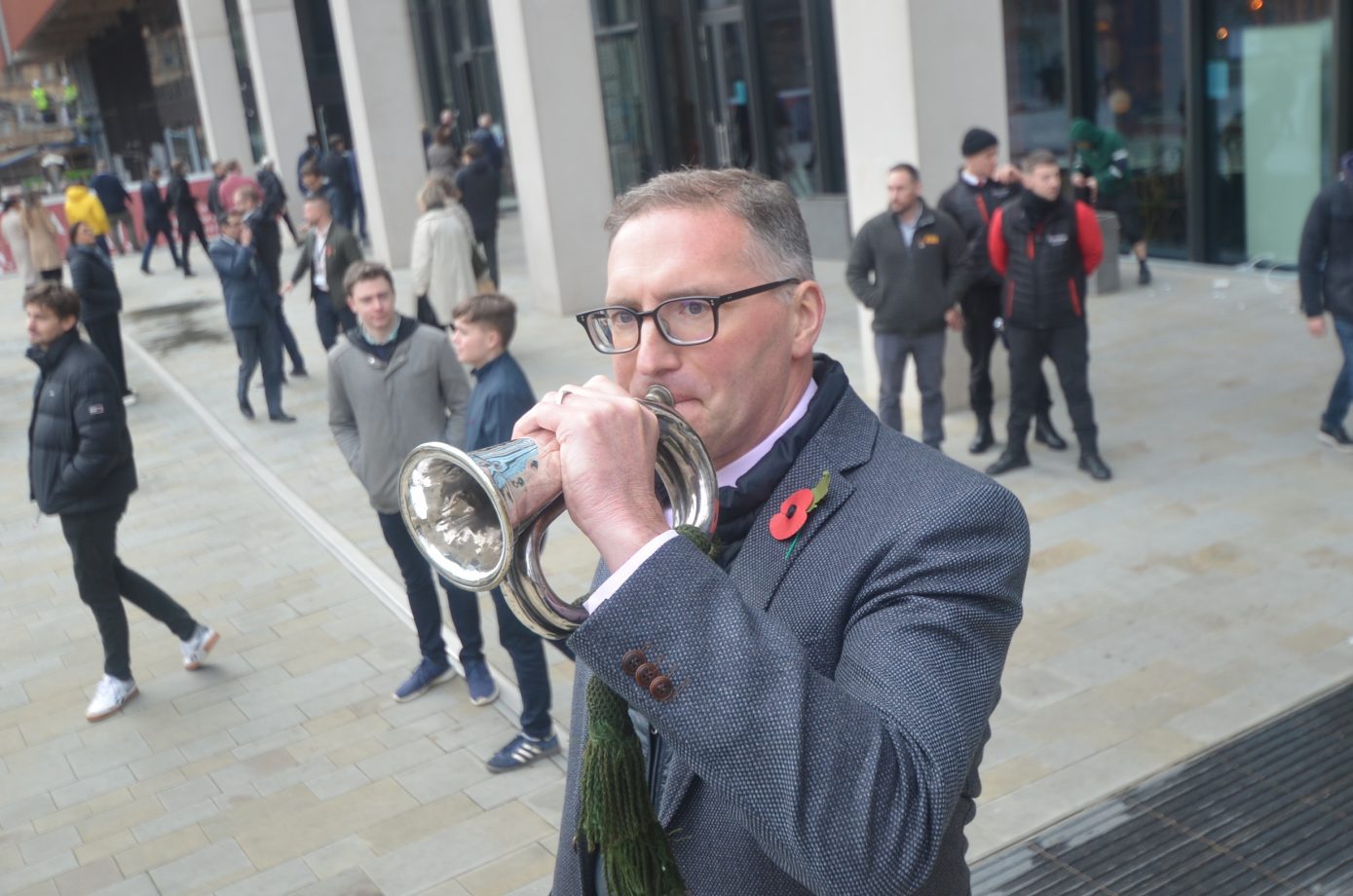
Paradise Birmingham has again marked Remembrance Day with a service in Chamberlain Square.
With support from many of the estate’s occupiers, this year we have again raised worthy funds for the Poppy Appeal and helped many across the estate feel connected to the sacrifice of those who came before us.
With a poignant playing of The Last Post at 11am, people paused for two minutes to think about all who have been affected by conflict around the world.
Coming together on an often chilly November morning each year should be seen as a personal as well as shared act of respect. And by our own humble remembrance we honour all who made the ultimate sacrifice.
This year was the fourth time we had our own bugler, who is an occupier based here at Paradise and gives his time to play for us here at Paradise, and it’s always a privilege to have an audience for this.
The bugle looks a very straight-forward instrument, yet like any brass instrument, it’s more difficult to play fluently than many realise.
Originally, bugles were used by the military for their reach across battlefields. This most humble of brass instruments had a knack of making itself heard.
The name ‘bugle’ represents both the appearance and origin of the instrument as a simple German hunting horn, and just as an animal’s horn is tapered at one end and flares at the other, so does the shape of the musical instrument.
Many of the British Army’s bugles in the Victorian era were made by Birmingham-based Gisborne & Son (originally based on Suffolk Street and later Vere Street), one of the country’s leading makers of brass instruments from its founding in 1839 until its closure in 1950.
The Last Post was first published as a piece of music in 1790, just one of dozens of bugle calls sounded daily in British Army camps.
In those days, soldiers didn’t have watches, so time in camp had to be marked another way. A trumpet, or bugle call, told the soldiers when to get up, when to eat, when to fetch the post, when to go on parade, and when to go to bed.
But it was not until the 1850s that another alternative role for the bugle call emerged.
When a soldier died overseas, there was often no music available to accompany him on his final journey. From that need, a new custom arose of the regimental bugler sounding the Last Post over the grave, or final resting place, of his fallen comrade.
At the same time, a new mood of democracy was working its way through society at the end of the Victorian era, and subsequent war memorials, such as those built for the Boer War, reflected this, with statues of generals on horseback replaced with more figurative sculptures inscribed with the names of ordinary soldiers instead.
Every time a memorial was unveiled from the late Victorian era onwards, it was always accompanied by the sound of the Last Post being played, as a symbol not only of passing, but also of remembrance – and of thanks.
By the time the First World War broke out in 1914, the Last Post was already a part of our national culture. During the war, it was played countless times at funerals across Europe, as well as at memorials all over the world. With mass conscription introduced as the war progressed, the differences between the civilian and the soldier broke down.
With millions of ordinary men from every walk of life now enlisted, a piece of music that had once belonged exclusively to a military culture was adopted by wider society.
Author HG Wells described the First World War as “a people’s war,” and the Last Post became “the people’s anthem.”
In the decades that followed, it became almost a sacred sound in an increasingly secular society. Used equally as often in Australia, Canada, New Zealand, India, Pakistan, Malaysia, and other countries, as well as in the UK, it was also played at independence ceremonies for former colonies and at the funerals of those who fought colonialism, from Mahatma Gandhi to Nelson Mandela.
But today’s event always resonates with the First World War in particular. Hostilities may have stopped at 11am on 11 November 1918, but the symbolism of this time and date lives on as a contemporary monument to the loss from not just those four years, but the wars that followed.
The bugle sounds for both friends and foes, as a symbol of democracy, and of unity.
But above all, it sounds for the ordinary soldier and for those left behind to mourn him.