Promoting Health Benefits

By Ross Fittall, Commercial Development Director at Federated Hermes MEPC
Paradise is determined to ensure the development makes a real difference to the communities in which it sits, both locally and regionally.
Part of this work is about measuring and reporting on the estate’s tangible socio-economic benefits, including improved health outcomes, which has been valued at £43 million by a leading research programme.
TRUUD (Tackling Root Causes Upstream of Unhealthy Urban Development) is based at the universities of Bath, Bristol, Manchester, Reading, Stirling and UWE Bristol, to help developers and investors like Federated Hermes MEPC to make positive decisions about how the health of the built environment impacts people.
Links have long been established between diseases such as type-2 diabetes, heart disease and poor mental health and the immediate environments of where we live.
TRUUD is collecting evidence and designing tools and interventions in partnership with industry, government and local communities to help promote the prioritising of health in urban planning for the benefit of all.
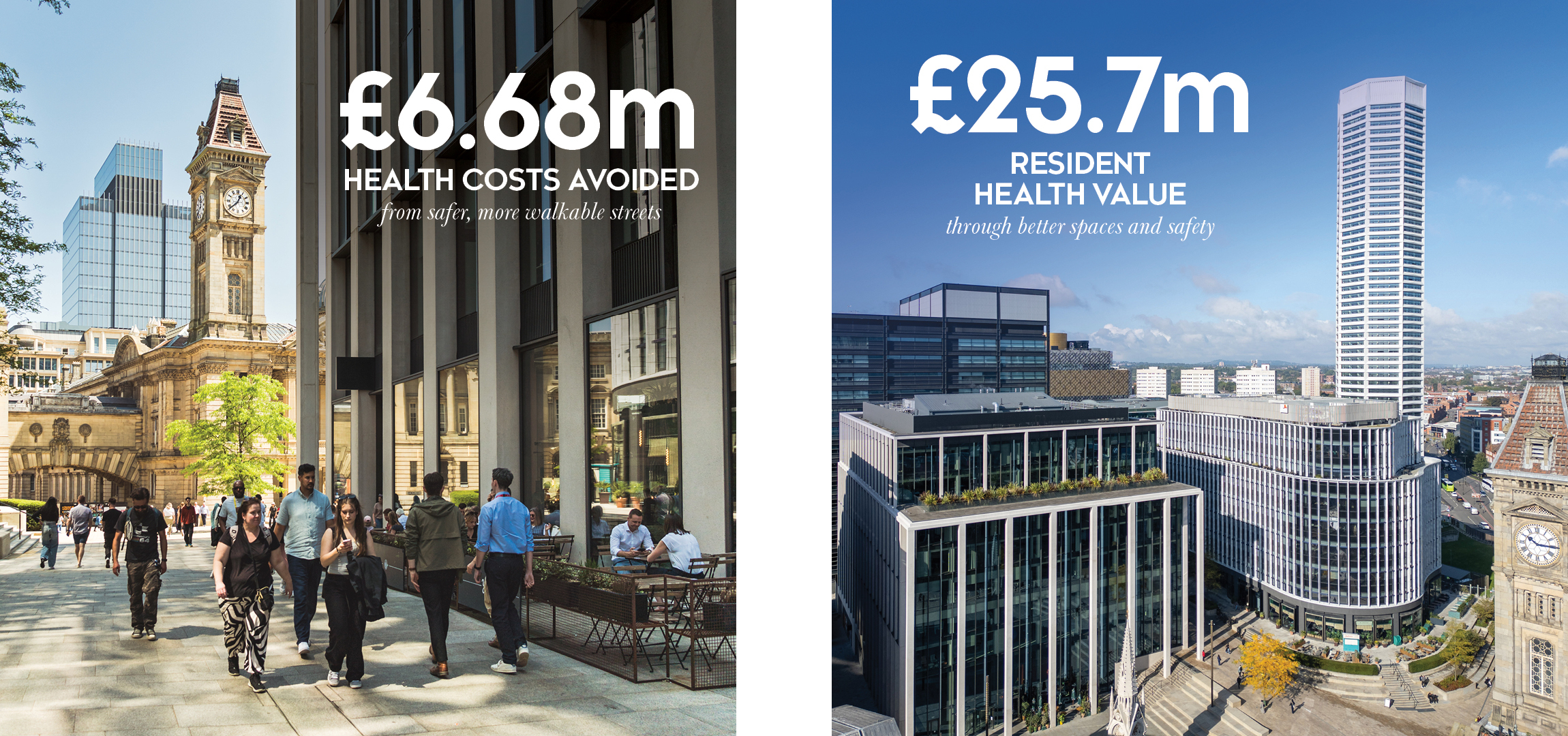
This is a priority that has been built into the planning, design, implementation and operation of Paradise from day one and which has already resulted in a whole raft of positive changes to the communities around it and the people who live there.
Removing traffic, improving pedestrian connectivity and creating new public realm where people can gather, dwell and enjoy events, are all central to Paradise and its ethos.
It is about delivering more than just new buildings that bring sustainable new occupiers, jobs, skills and opportunities to the city, but also being part of a ripple effect of supporting wider regional growth.
Paradise has transformed how people access and use this part of the city centre. Examples of this include major road changes and by actively supporting active transport options, especially walking, running and cycling, and by limiting car parking and promoting public transport.
The initial TRUUD findings estimate that Paradise Birmingham, including its future Phase 3, will deliver up to £43 million in health benefits for the area around it, which is approximately £20 million more than originally expected in the city council’s Local Plan.
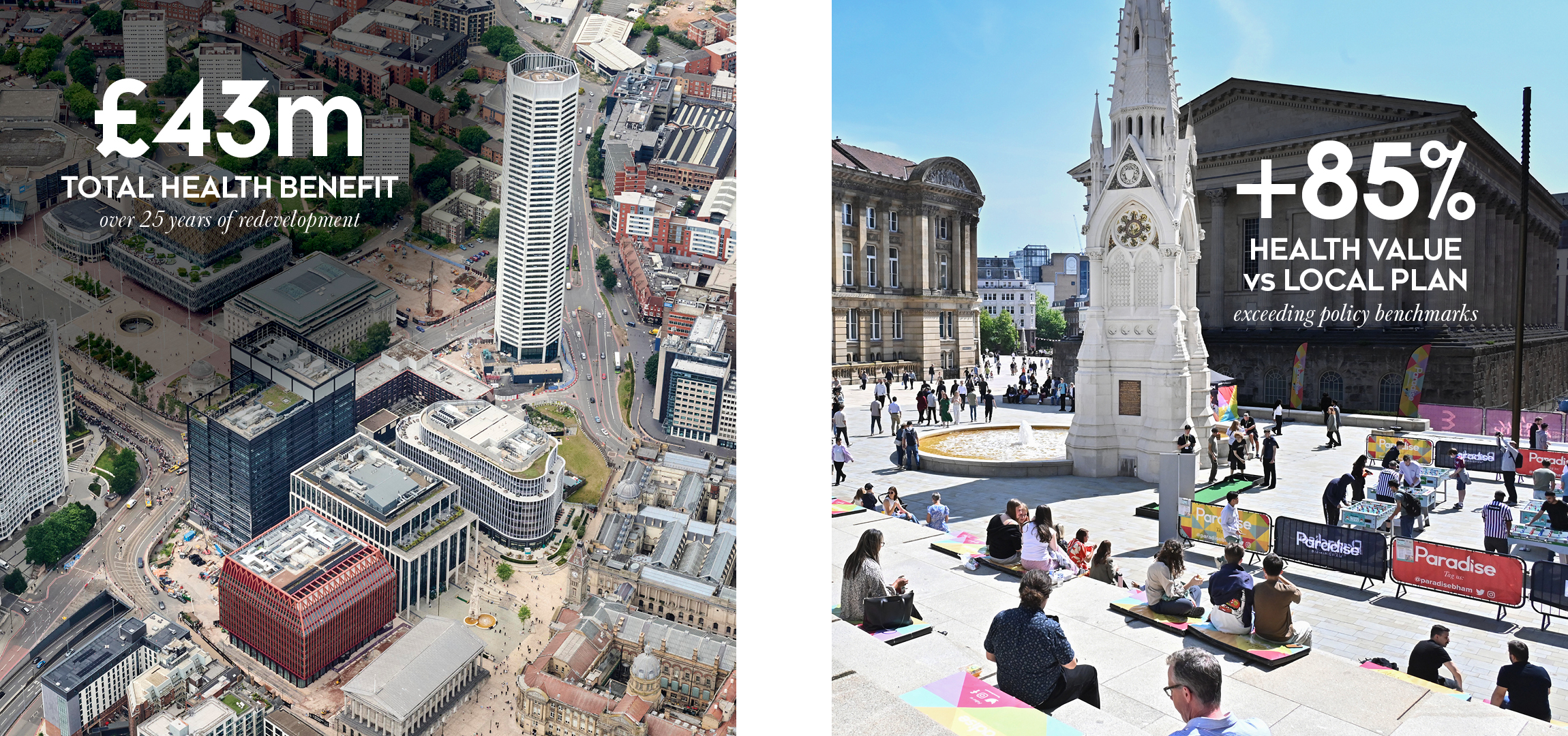
Much of this impact is driven by a modal shift to more active forms of travel, improved opportunities for walking and feelings of security created and supported by the development.
The report also showed that further improvements to increase green space, mitigations for noise and air pollution and the removal or downgrading of further roads, could provide an ideal scenario for increasing the health benefits even further.
These findings underline the role and potential of major urban regeneration projects to deliver socially and environmentally beneficial outcomes. Researchers at the University of Bath applied their Health Appraisal of Urban Systems model (HAUS) to consider aspects that could benefit or harm health such as walking routes, cycle facilities, public transport, road collisions, air quality, noise, fear of crime, green and blue spaces, tree cover, overheating risks and access to quality food.
HAUS allows investors, developers and planners to consider and adjust a range of built environment health factors. The resulting reports provide estimates of costs attributable to conditions at different stages: before development, development compliant with the city’s Local Plan, phases of building completion and an ideal scenario.
The positive outcomes at Paradise already recorded and the projected future benefits provide both a blueprint and benchmark for other city centre developments not just in Birmingham, but across the UK.